Gilt, Leaf or Solid Gold: Three Different Surface Stories
Gilt, leaf, or solid gold changes how an object catches light and how it is made; learn to spot the differences and choose the right finish.
A gold-colored edge that looks rich in a display case can turn dull, patchy, or unexpectedly delicate in daily use. Gilt, gold leaf, and solid gold create different surface stories: one adds a gold layer, one lays down exceptionally thin gold, and one makes the object itself from gold alloy. Knowing which you are looking at helps explain both the appearance and the likely source of a surface problem.
This is not a ranking by value. It is a way to match a finish to its intended effect and to understand what can go wrong when an object is handled, cleaned, or repaired without regard for how its gold was applied.
Why do these three gold surfaces get confused?
In ordinary light, all three may read as gold. A carved frame, a leafed picture border, and a solid-gold ring can share a warm gleam while behaving very differently at a corner or along a worn edge. Color alone cannot tell you how much gold is present or how it is attached.
“Gilt” broadly describes a surface treated with gold or a gold-like finish. It can refer to gold leaf applied over another material, or to a metallic layer produced by another process. Gold leaf is actual gold beaten or made into extremely thin sheets, then attached to a prepared surface. Solid-gold objects are made from gold alloy throughout, rather than wearing gold only at the surface.
Terms on labels can vary, and “gold finish” may describe something other than gold. If the distinction matters for an object, check its maker’s description or ask a conservator, jeweler, or knowledgeable dealer instead of relying on appearance.
What does each surface look like?
Gilding can look smooth and even, especially when the gold layer is fine and the object has a carefully prepared base. On furniture, frames, or architectural details, the finish may follow raised carving and settle into recesses. A flat, uniform sheen can also come from a gold-colored coating, so the word “gilt” by itself does not identify the exact material or process.
Gold leaf often has a lively, close-up character. Depending on the preparation and the way the leaf is laid, its surface may show subtle joins, small variations in reflection, or the contours of the ground beneath it. A leafed surface can appear exceptionally bright on a smooth area and softly irregular across carved or textured work. Those details are not automatically flaws; they can be evidence of the handwork and substrate.
Solid gold tends to show the same underlying material wherever the object is exposed, though its color and hardness vary with the alloy and finish. Scratches do not reveal a different base layer in the way wear can on a coated object. A polished solid-gold curve may reflect light sharply; a brushed or engraved one scatters it into a quieter glow.
Why does a gold finish turn patchy or dull?
A patchy appearance usually starts with a difference in the surface, not with gold simply “losing its color.” On a gilded object, abrasion can thin or remove the upper layer and expose the material beneath. Repeated contact at corners, handles, or raised details often makes those places look different first.
Leaf can lift or break where its support is uneven, poorly bonded, or repeatedly flexed. Dust and grime can also mute its reflection, while aggressive rubbing may disturb the delicate surface. A solid-gold object can become scratched, dulled by residue, or marked by contact with other materials, but its visible gold is not a thin skin over a different base.
Try this order before deciding on a repair:
- Look without touching. Note whether the change is at edges, high points, joins, or broad flat areas. A pattern can suggest wear, lifting, or deposited grime.
- Check the object’s description. Look for terms such as gold leaf, gilded, gold plated, gold-filled, or solid gold; they do not mean the same thing.
- Consider the object’s use. A frequently handled knob or wearable item faces different contact from a framed ornament kept on a shelf.
- Pause before cleaning. Avoid polishing compounds, abrasive cloths, solvents, and improvised scraping on an unidentified finish.
- Choose the next help by material. A conservator is suited to fragile decorative surfaces; a jeweler can assess jewelry and its construction.
For an uncertain finish, gentle observation is more useful than a vigorous cleaning attempt.
What should you do when gold leaf lifts or flakes?
Loose leaf is easy to mistake for dust or a bit of dirt, especially around a frame or carved ornament. The temptation is to press it down with a fingertip or brush the area clean. That can catch a lifted edge and carry away more material.
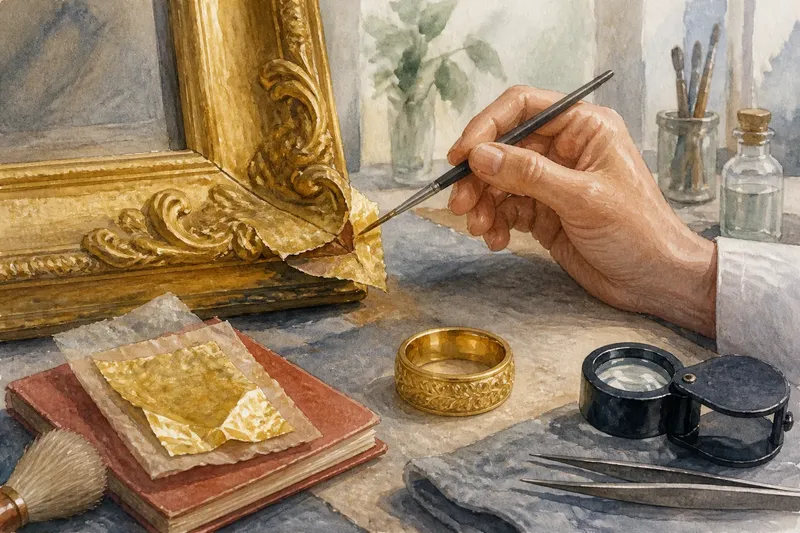
Instead, keep hands, cloths, and vacuum nozzles away from the loose area. Place the object somewhere it will not be bumped, and avoid moving it by the damaged section. If the object matters to you, photograph the area in steady light and consult a conservator who works with gilded surfaces. A suitable repair depends on the ground, adhesive, leaf, and any existing coating; adding household glue or fresh leaf can make later treatment harder.
Say you inherit a small carved frame with a bright gold corner and a neighboring corner where the surface curls. If you stop dusting that edge and seek advice before applying polish, the conservator can inspect the lifting material without you having disturbed it further. The expected observable result is a clearer assessment of what is loose and what kind of treatment, if any, is appropriate.
Why does a polished object lose its even shine?
On solid gold, an uneven shine often comes from fine scratches, skin oils, or residues gathering in details. Alloy composition also affects color: gold mixed with other metals may look paler, redder, or more muted than a viewer expects. A surface that looks less mirrorlike is not necessarily damaged or in need of heavy polishing.
On gilded work, polishing is a different matter. A cloth or compound intended for jewelry can wear through a thin finish or disturb leaf. For a solid-gold piece, cleaning advice still depends on the item’s construction, stones, soldered components, and maker’s care guidance. Where those details are unclear, a jeweler can advise on a suitable approach.
Imagine a solid-gold pendant looks hazy around its recessed engraving, while the raised edges remain bright. If the owner first checks the care information and asks a jeweler before using a polishing paste, the likely next step is to identify whether the haze is residue or a surface change. That distinction helps avoid treating every loss of sparkle as a need for abrasion.
Which construction suits a particular object?
Gilding is useful when a maker wants gold across a form that would be impractical to construct entirely from gold. It can bring a luminous surface to wood, plaster, or other prepared supports, and it allows gold to follow elaborate carving. Its visual effect depends on the ground and finish as much as on the gold layer.
Gold leaf is a way to create a thin, reflective skin over a prepared surface. It suits decorative work where the gold itself is meant to catch the eye, while the support provides shape and structure. It can be applied to broad fields or intricate detail, but the delicacy of the surface calls for care in handling and maintenance.
Solid gold makes sense when the material needs to continue through the object, as in jewelry or small forms shaped from gold alloy. It can be engraved, polished, or given a textured finish, and wear does not uncover a non-gold base. The choice involves more than appearance: weight, construction, intended use, and the maker’s design all matter.
What should you ask before choosing a gold finish?
How can I tell whether an object is gold leaf?
Look for a description from the maker, seller, or collection record and observe the finish without rubbing it. Tiny joins or changes across a prepared surface may be consistent with leaf, but appearance alone cannot confirm the construction.
Does “gilt” mean the object is made of gold?
Usually, it means gold or a gold-like material has been applied to a base rather than that the whole object is gold. Ask what material was applied and what lies beneath it if that distinction affects care or design decisions.
Can I polish a leafed frame?
Do not treat leaf as if it were solid metal; polishing can abrade or lift the surface. For a valuable or fragile frame, ask a conservator how to handle dust and whether the finish needs attention.
Why does solid gold come in different colors?
Gold is commonly combined with other metals to make an alloy, and those additions affect its color and working qualities. The finish—polished, brushed, or textured—also changes how the color appears in light.
How can you judge the right surface story?
Start with the object’s purpose, then decide what the gold is meant to do. If it should cover a carved support, gilding or leaf may be the relevant language. If the gold needs to run through the material of a wearable object, solid-gold construction may fit better. Ask whether the desired look is smooth and even, subtly varied, or shaped by the object’s own metal surface.
For a design decision, request a sample or inspect a finished piece under the light where it will be seen. A leafed sample can reveal how joins and texture catch light; a gilded sample shows the relationship between coating and support; a solid-gold sample lets you see the alloy and finish together. Keep the comparison focused on appearance and making, not on assuming that the brightest surface is the best one.
When you encounter gilt, leaf, or solid gold, the useful question is not simply “How much gold is there?” Ask what holds the surface in place, what the maker wanted the light to do, and where handling will touch it. That small shift turns a shiny finish into a readable part of the object.