How Gold in Medieval Manuscripts Directed the Eye Across the Page
Gold in medieval manuscripts could guide attention through initials, borders, and images. Learn how to read each detail in its specific page context.
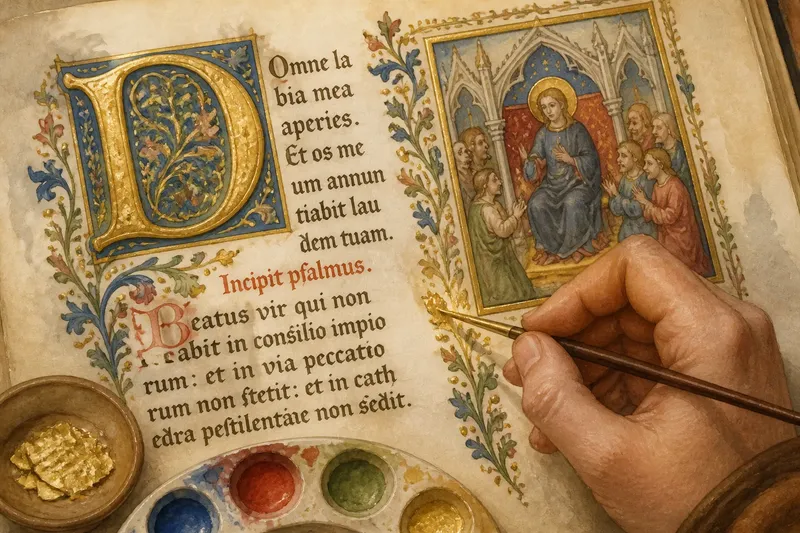
On a medieval manuscript page, a gold initial beside a block of writing could catch the eye before the first line did. Gold in medieval manuscripts was used in particular contexts, not according to one rule shared by every book: its position among text, images, borders, and open parchment shaped what a viewer noticed.
A useful way to read a decorated page is to ask what the gold touches, interrupts, or sets apart. The metal’s brightness is only one clue; the surrounding design helps explain its role.
How could a gold initial open a passage?
An enlarged initial at the beginning of a text section provides a visible starting point. On a page where most letters are similar in size, a decorated opening letter stands apart. Gold may strengthen that distinction, while the letter’s scale, shape, and neighboring ornament also contribute.
What the initial introduces depends on the manuscript and its layout. It may begin a new text, a chapter, a prayer, or another division. The gold alone does not identify which one: the wording, headings, and nearby changes in the page’s arrangement provide context.
Imagine a reader opening a manuscript to a page with several blocks of writing. One block begins with a large gold initial, while the others begin with ordinary lettering. The reader can spot that decorated opening quickly; checking its heading and text then helps identify the section it marks.
Look for the change in the text as well as the bright letter.
What could a gold border connect?
A border may frame a block of writing or image, but its function is not always simply to enclose. It can also lead toward a nearby initial, link text with an illustration, or give a decorated area a distinct edge. Some borders are interrupted or mingle with leaves and small figures, so their route matters.
Trace the line visually and notice what it touches or approaches. A closed frame around an image suggests a different arrangement from a border that continues toward the text, though neither feature on its own settles the meaning.
Why might gold appear beside an image?
Gold could be applied selectively to a detail such as a halo, throne, vessel, or part of a garment. Against the surrounding paint or parchment, that accent may draw attention to a figure or object. Its role varies with the image; gold does not automatically identify the most important subject.
Color and composition offer additional clues. A gold detail beside blue, red, or green may stand out differently than one surrounded by open parchment. Scale, position, gesture, and the relationships among figures all contribute to how a scene is read.
Say a miniature shows several figures, with gold around one figure’s head. The halo gives that figure a bright visual distinction, while the figures’ gestures and positions help explain their relationship. In this invented situation, the observable result is emphasis on one figure, not a complete interpretation supplied by gold alone.
How can gold mark a change in reading?
A decorated heading or gold-accented initial may signal a transition before a reader has parsed the words. In some manuscripts, such visual differences help separate sections or distinguish a heading from the surrounding text. The exact purpose depends on the manuscript’s own system of lettering, spacing, and decoration.
At the point where gold appears, check whether the text, speaker, subject, or kind of material changes. If it does, the gold may reinforce a boundary or opening; if not, it may emphasize a detail without marking a new section.
What does the space around gold tell you?
Gold can feel prominent when it sits apart in open parchment. Repeated along a border, it may instead contribute to a visual rhythm around a larger area. In a crowded miniature, a small gold detail shares attention with many other features.
Blank space matters, too. A gap before a heading can give the eye a pause, while closely packed writing and ornament can make a page feel continuous. Compare the gold with both the decorated elements and the untouched parchment before deciding what stands out.
Which clues help interpret gold on a manuscript page?
Does every gold initial mark a major division?
No. Its size and location are clues, but the neighboring words, headings, and initials help show what kind of division it marks. Compare nearby examples on the same page when possible.
Is a gold border always a frame?
No. It may enclose an area, connect text and image, or guide the eye toward another detail. Follow its route and note where it begins, ends, or meets other decoration.
Does gold always identify the most important figure?
No. Gold can emphasize a figure or object, but position, scale, gesture, and color also shape the image’s visual order. Read the gold alongside those features.
What should I check before calling a detail symbolic?
First identify where it appears: in the writing, an image, a border, or a transition between sections. Then compare it with neighboring details and the page’s layout; if the context does not support a particular reading, leave the interpretation open.
How does the whole page shape gold’s role?
A manuscript page brings together writing, initials, headings, images, borders, and open parchment. Gold participates in that arrangement rather than carrying a single fixed meaning. A small accent can introduce a passage in one place and draw attention to an object in another.
For gold in medieval manuscripts, start with the first detail that catches your eye, then follow its relationship to the text, image, border, and surrounding space. That close reading makes it easier to distinguish what the page visibly emphasizes from what its broader context may suggest.