How to Look Closely at a Gold Object in a Museum
A gold object museum visit becomes more rewarding when you compare its outline, surface, and neighboring materials before deciding what catches your eye.
A gold object museum visit gets richer when you look at its edges before its shine. Choose one object, settle where you can see it comfortably, and give its outline, surface, and nearby materials separate turns of attention. That small pause can reveal how the object directs your eye—and what the gold is doing beyond looking bright.
What does the outline ask you to notice?
Start with the silhouette, not the details. Is the object broad and low, narrow and upright, symmetrical, or irregular? Notice whether its outline is easy to grasp at a glance or broken into small projections, handles, loops, and points. Those shapes determine how much of the object you take in at once.
Then follow the contour slowly with your eyes. A smooth rim can make a vessel feel contained; a jagged edge may make a small object seem more animated. Look for places where the outline changes direction. A raised knob, a curled wire, or a flared lip can catch attention before the larger body does.
Stand where you can see the whole form without leaning or pressing close to a case. If the label identifies the object’s use, keep that information in reserve for a moment. Looking first lets you notice the shape on its own terms.
Ask yourself: if the gold were dark, would the outline still hold your attention?
How does the surface change as you look?
Once you have the shape, look across the surface rather than straight into its brightest patch. Gold may appear smooth, patterned, folded, hammered, engraved, or worn. A repeated mark can give a surface rhythm; a quiet, unbroken area can make a nearby detail seem more deliberate.
Notice how the display lighting travels. Does a highlight follow a curve, collect along an edge, or break into small flashes? The reflection may shift when you move a little to one side, while the engraved lines or raised decoration remain in place. That difference helps separate what belongs to the object from what comes from the room.
Look for transitions: a polished edge beside a dull field, a shallow mark interrupting a smooth plane, or a dark recess beneath a raised form. These contrasts can make the object legible without requiring a strong overall shine.
Keep a comfortable distance from the case and follow any gallery guidance. You do not need to get close enough to inspect every mark; noticing where the surface changes is often more useful than cataloging details.
What changes when gold sits beside another material?
Look just beyond the gold. Does it meet glass, stone, enamel, wood, fabric, or a darker metal? Notice the boundary between them: a clean seam, a setting, an overlap, or a narrow strip that keeps the materials apart. The join can tell you where one material ends and another begins, even when the object reads as a single design.
Compare the neighboring surface with the gold. A matte material may make the gold’s reflections more noticeable; a glossy one may echo them. A colored stone can pull your eye away from the metal, while a pale background may make the gold’s edges harder to separate. These effects depend on the object and its display, so look at what is actually there rather than assigning a fixed meaning to each pairing.
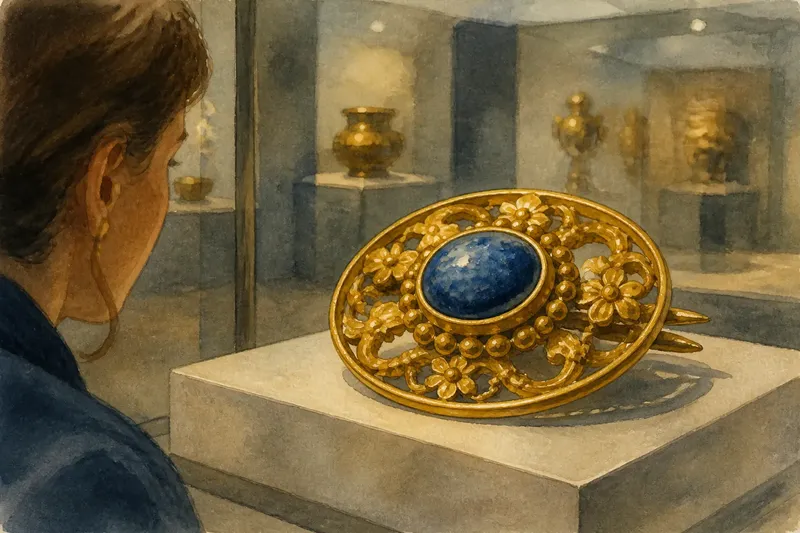
Say you are looking at a small gold brooch set with a blue stone. First, trace the brooch’s outline; next, notice whether the gold around the stone is smooth or patterned; then compare the stone’s shine with the metal’s reflection. You may find your eye settles on the blue center, or that the gold setting becomes more noticeable because it frames the color. Either response gives you a specific feature to return to.
Why does one detail keep pulling your eye?
Attention often moves between the object and its surroundings. A bright edge might catch you first, but a dark recess may hold your gaze longer. A compact shape can feel prominent beside a large neighboring object, while a finely decorated surface may reward a slower look after the initial impression fades.
Try identifying the exact cue rather than saying only that the object “looks beautiful.” Is it the outline, a repeated mark, a strong contrast, a reflection, or the way two materials meet? Naming the cue turns a first impression into a clearer observation. It also gives you a way to compare what you notice now with what you saw at the beginning of the visit.
Give yourself a brief pause before reading the label, then read it if you wish. Information about the object’s purpose or making can sharpen your interpretation, but it need not replace the visual details you already observed.
Questions to ask during a gold object museum visit?
Should I look at the object before reading its label?
A short look first can help you form your own observations about shape, surface, and material. Reading afterward may add context without erasing that first visual impression.
What if the case reflects the gallery lights?
Shift your position slightly if the viewing area allows it, and focus on edges or engraved details that remain visible. Avoid touching the case or blocking other visitors while you adjust your view.
How can I tell which material catches my eye?
Look away briefly, then return to the object and notice where your gaze lands first. Compare that spot with the boundary between gold and its neighbors; the feature may be the contrast or setting rather than the gold alone.
Should I spend time on the label’s technical terms?
Read the label when you want context, especially if it names a material or process you do not recognize. If a term changes how you understand the surface, look back at the object and see whether you can locate the feature it describes.
How can you leave with a sharper observation?
Before moving on, choose one detail you can describe plainly: a flared rim, a worn patch, a stone held by a narrow gold border, or a reflection that breaks across a patterned surface. That note will be more useful than a general memory of brilliance because it preserves what made this particular object hold your attention.
A gold object museum visit does not need a long checklist or specialist vocabulary. One outline, one surface change, and one material boundary are enough to give your eyes a route through the display. As you leave, notice whether the first feature you saw is still the one you remember—or whether a quieter detail has taken its place.